Series: From Drawing to Nameplate: How an ASME Filter Housing Is Built — Part 1 of 4
Engineering and Design
A liquid-filter housing can look simple from the outside: a shell, a closure, nozzles, legs and a nameplate. The engineering question is not simple. Before a shop cuts plate or pipe, somebody has to define what pressure the vessel will see, what temperature it will see, what fluid it will hold, what corrosion or compatibility allowances matter, and what records will prove the design basis later.
This installment keeps the discussion inside ASME Boiler and Pressure Vessel Code Section VIII, Division 1. ASME’s public scope summary says Division 1 provides requirements for the design, fabrication, inspection, testing and certification of pressure vessels operating at internal or external pressures exceeding 15 psig. It also says the division includes requirements for several material classes, fabrication methods and ASME Product Certification Marks. That public summary is useful context, but it is not the controlled code text. Exact paragraph references, allowable stresses, test factors and acceptance criteria should be confirmed against the governing code edition during technical review.
The design basis comes before the rating
A pressure rating is not a complete specification. For a hypothetical example, imagine a duplex-bag filter housing proposed for a plant cooling-water sidestream. The proposal says “150 psi ASME code vessel.” That phrase does not answer whether the proposed housing is suitable for the actual service. The engineer still needs the design pressure, design temperature, operating pressure range, possible surge conditions, clean and dirty differential pressure assumptions, expected fluid chemistry, solids loading, corrosion allowance, vent and drain needs, closure style, support loads and any external-pressure or vacuum case.
Section VIII, Division 1 is a construction framework. It does not remove the need for a clear process basis. It organizes how the vessel is designed and documented once the service conditions are defined. A buyer who approves only a nominal pressure rating may miss the real question: under what design conditions, materials, geometry and certification scope is that rating being offered?
Internal pressure, external pressure and temperature
Filter housings are usually discussed as internally pressurized vessels, but that is not the only case a designer should consider. ASME’s Division 1 public scope explicitly refers to pressure vessels operating at either internal or external pressure. A liquid housing may see unusual external-pressure or vacuum conditions during draining, steam-out, pump suction, blocked vents or cleaning procedures. Whether those cases govern the design is project-specific, but they belong in the design conversation before fabrication.
Temperature belongs there too. A housing that is acceptable for ambient water service may not be suitable for a hotter solvent, a low-temperature outdoor installation or a cleaning cycle that changes gasket behavior. The public ASME scope summary notes that Division 1 applies requirements to several classes of material used in pressure-vessel construction. It does not give the reader a shortcut to choose materials from a brochure. The project record should identify the governing BPVC edition and the temperature assumptions used in design.
Materials are design inputs, not afterthoughts
Material selection is not Part 2’s paperwork problem alone; it starts in engineering. Carbon steel, stainless steel and other alloys can all be reasonable choices in the right service, and poor choices in the wrong one. In a filtration application, the wetted boundary may include the shell, nozzles, basket or cartridge hardware, closure parts, vents, drains and seals. Section VIII design work must be kept distinct from broader chemical-compatibility review, but the buyer still needs both. A vessel can be code-built and still be poorly specified for the fluid if corrosion, temperature, cleaning chemistry or elastomer compatibility were not defined.
For Part 1, the practical point is this: engineering should state the material assumptions before the manufacturer prices or builds the housing. Part 2 will look at material records and traceability in more detail.
Geometry affects more than the drawing
Pressure vessels are not generic containers. A shell, head, nozzle, closure and support arrangement each creates design questions. A secondary technical explainer from Wermac describes common pressure-vessel shapes as cylinders, cones and sphere-derived forms, and notes that cylindrical vessels with formed heads are common. Pressure Vessel Engineering, a secondary engineering source, emphasizes that design calculations and shop drawings are part of vessel work and that external pressure, heads, supports and unusual openings can complicate otherwise routine designs.
For a filter housing, geometry also affects maintenance. A swing-bolt closure, band clamp, davit, basket hold-down, cartridge seal plate or side inlet may be easy to describe commercially but still require design review as part of the vessel assembly. Openings and attachments should not be treated as minor accessories after the shell is selected. They are part of the engineered pressure boundary or its support system when they affect the vessel design.
Drawings and calculations guide fabrication
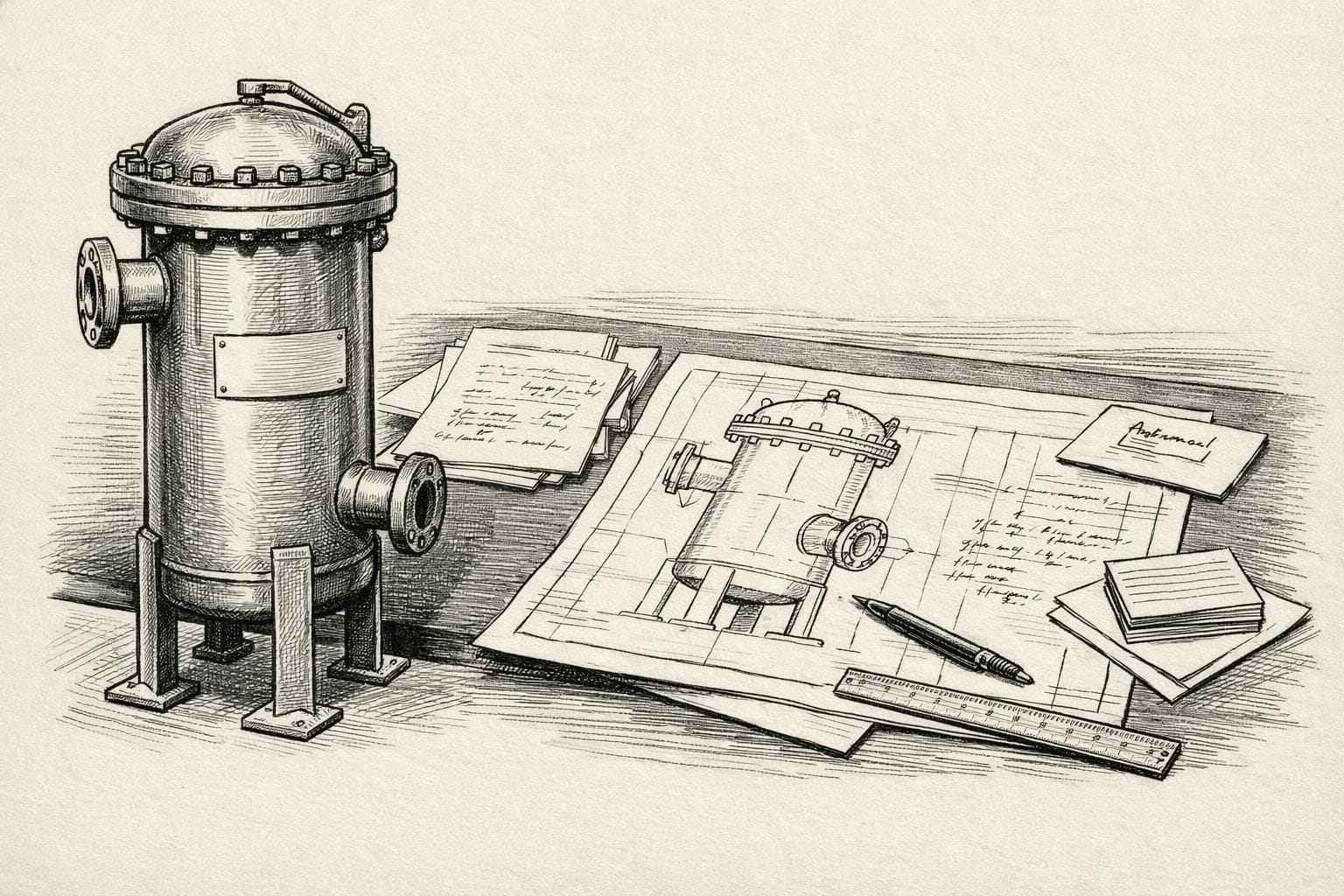
The drawing is the shop’s map. It should identify the vessel configuration, nozzle locations, design conditions, materials, weld and examination notes, nameplate information and purchaser requirements. Calculations support the drawing by showing the design assumptions and methods used. Specifications tell the manufacturer which requirements apply beyond the bare pressure boundary: documentation package, hold points, coating or passivation expectations, gasket requirements, drain orientation, lifting provisions and any project-specific restrictions.
ASME’s broader BPVC page says the code is updated as technology changes and that ASME releases a new BPVC edition every two years. That matters because “built to ASME” is incomplete unless the project record says which edition and addenda apply. A buyer does not need to audit every formula, but the buyer should know that a controlled design basis exists and that the supplier can produce the records needed for review.
Certification is a system, not a sticker
ASME’s certification pages describe quality-program review, required standards, Authorized Inspection Agency arrangements, quality manuals and personnel training as part of certification. Its certification-process page says the review or survey evaluates the applicant’s quality manual and implementation of the quality program, and that ASME grants a certificate only after successful demonstration of implementation.
For buyers, the lesson is to avoid reducing certification to a logo on a brochure. Ask what certificate scope applies, who is responsible for design, what records will be supplied and whether the proposed vessel will receive the applicable certification marking and data report. The National Board source reviewed for this article was most useful as limited context for the pressure-equipment ecosystem and overpressure-protection activities; it was not used here to define vessel design rules.
Questions to ask your housing supplier
- What design pressure, design temperature and governing BPVC edition are used for this housing?
- Are external pressure, vacuum, surge, blocked-discharge or cleaning conditions considered? If not, why not?
- What corrosion allowance and material assumptions are included in the design?
- Which wetted components are pressure-boundary parts, and which are internal filtration components or seals?
- Will the supplier provide drawings and design calculations for review?
- What certificate scope, Authorized Inspection Agency involvement and data-report documentation apply?
- What purchaser specifications are being treated as requirements, and which items are only manufacturer preferences?
- Which exact code details still require technical review against controlled Section VIII, Division 1 text?
Series navigation
This is Part 1 of a four-part series. Parts 2 through 4 will cover materials requirements, fabrication and welding requirements, and examination, inspection, testing and certification. Links should be added only after each installment is published.
Sources and further reading
- BPVC.VIII.1 - BPVC Section VIII-Rules for Construction of Pressure Vessels Division 1, ASME, publication date not listed, observed Oct. 4, 2026. Supports the Section VIII, Division 1 scope used in this article.
- ASME Boiler and Pressure Vessel Code (BPVC), ASME, publication date not listed, observed Oct. 4, 2026. Supports BPVC context and edition-awareness discussion.
- Certification and Accreditation, ASME, publication date not listed, observed Oct. 4, 2026. Supports quality-program and certification context.
- ASME Certification Process, ASME, publication date not listed, observed Oct. 4, 2026. Supports discussion of quality manual review and certificate issuance process.
- ASME Code Pressure Vessel Design, Pressure Vessel Engineering, May 1, 2018, observed Oct. 4, 2026. Secondary source used for design-calculation, drawing and external-pressure context; not treated as code authority.
- Spherical and Cylindrical Pressure Vessels, Wermac, publication date not listed, observed Oct. 4, 2026. Secondary source used for general vessel-geometry context; not treated as code authority.
- Pressure Relief Lab, National Board of Boiler and Pressure Vessel Inspectors, publication date not listed, observed Oct. 4, 2026. Limited context for National Board pressure-equipment support activities; not used to define Section VIII vessel design requirements.