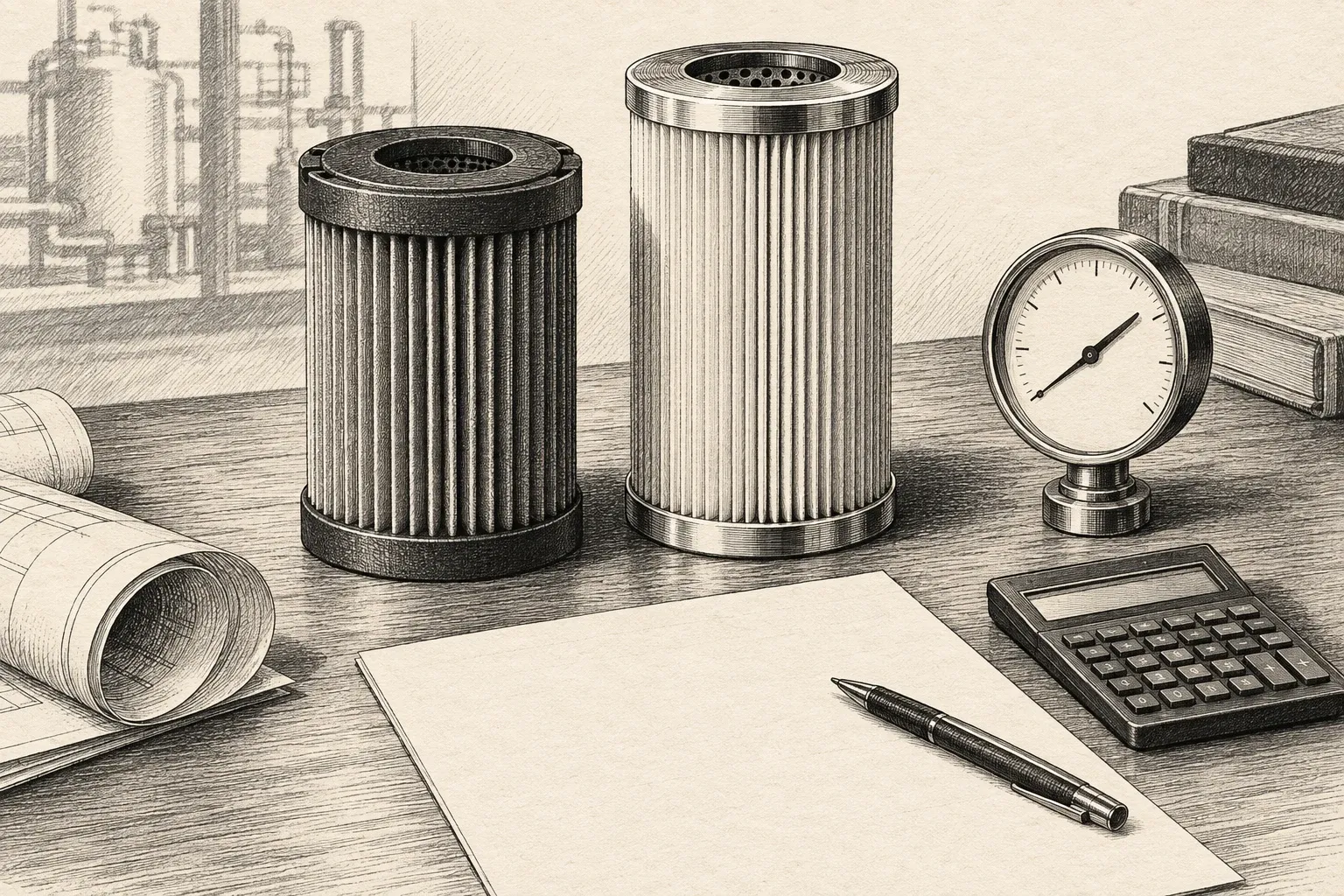
A filter quotation puts the purchase price in plain sight. The operating consequences are less obvious. For compressed-air filtration, an economic comparison needs to keep the required air quality fixed while examining pressure loss, maintenance and system behavior.
Do not buy a lower standard of performance
DOE’s Maintaining System Air Quality tip sheet advises defining the air quality required by the end use before choosing treatment. It also notes that filter pressure drop rises as elements foul. A cheaper option that does not meet the required duty is not an economic alternative to the specified one.
Our editorial approach is to compare acceptable candidates first, then examine cost. Do not relax a safety, equipment or product-quality requirement to improve a spreadsheet result.
Use plant data, not an inherited savings percentage
DOE’s compressed-air cost guidance uses operating hours, load duty, power and electricity cost to establish the cost of compressed air. Its examples are from 2004; their historical energy prices are not current quotations or suitable assumptions for every plant.
DOE’s maintenance tip sheet connects dirty pipeline filters with additional pressure drop and illustrates the possible energy consequence in a particular compressor scenario. It also calls for maintenance according to manufacturer specifications. The example is not a universal conversion from pressure loss to savings.
An illustrative comparison
Consider two hypothetical options that have already been approved for the same duty. If Option A needs 12 elements a year at $50 each, its element spend is $600. If Option B needs six at $80 each, its element spend is $480. B costs more per element but $120 less in annual element purchases.
Those figures are invented solely to show the arithmetic. They exclude labor, downtime, energy, shipping and disposal, and do not predict service life. Do not infer that a higher-priced element necessarily lasts longer.
A useful annual worksheet adds element spend, service labor, disposal and other documented costs. Add an energy difference only where measured system data or a justified engineering model supports it. Avoid counting an energy benefit twice through both a compressor-cost estimate and a separate savings line.
The comparison must survive a sensitivity check
Ask what happens if service life is shorter, operating hours change or the tariff differs. If a result reverses under small changes in an uncertain assumption, label the decision accordingly rather than presenting one precise payback number.
The best quotation is not automatically the lowest purchase price or the highest claimed efficiency. It is the approved option whose performance and total-cost assumptions remain credible in the actual plant. Qualified personnel must determine treatment requirements and any operating changes.
Sources and further reading
- DOE: maintaining system air quality (2004 PDF)
- DOE: determine the cost of compressed air (2004 PDF)
- DOE: preventive maintenance strategies (2004 PDF)
Sources reviewed October 4, 2026. Manufacturer literature describes particular products and is not an independent performance endorsement. This article is an editorial guide, not a site-specific design or operating procedure.